
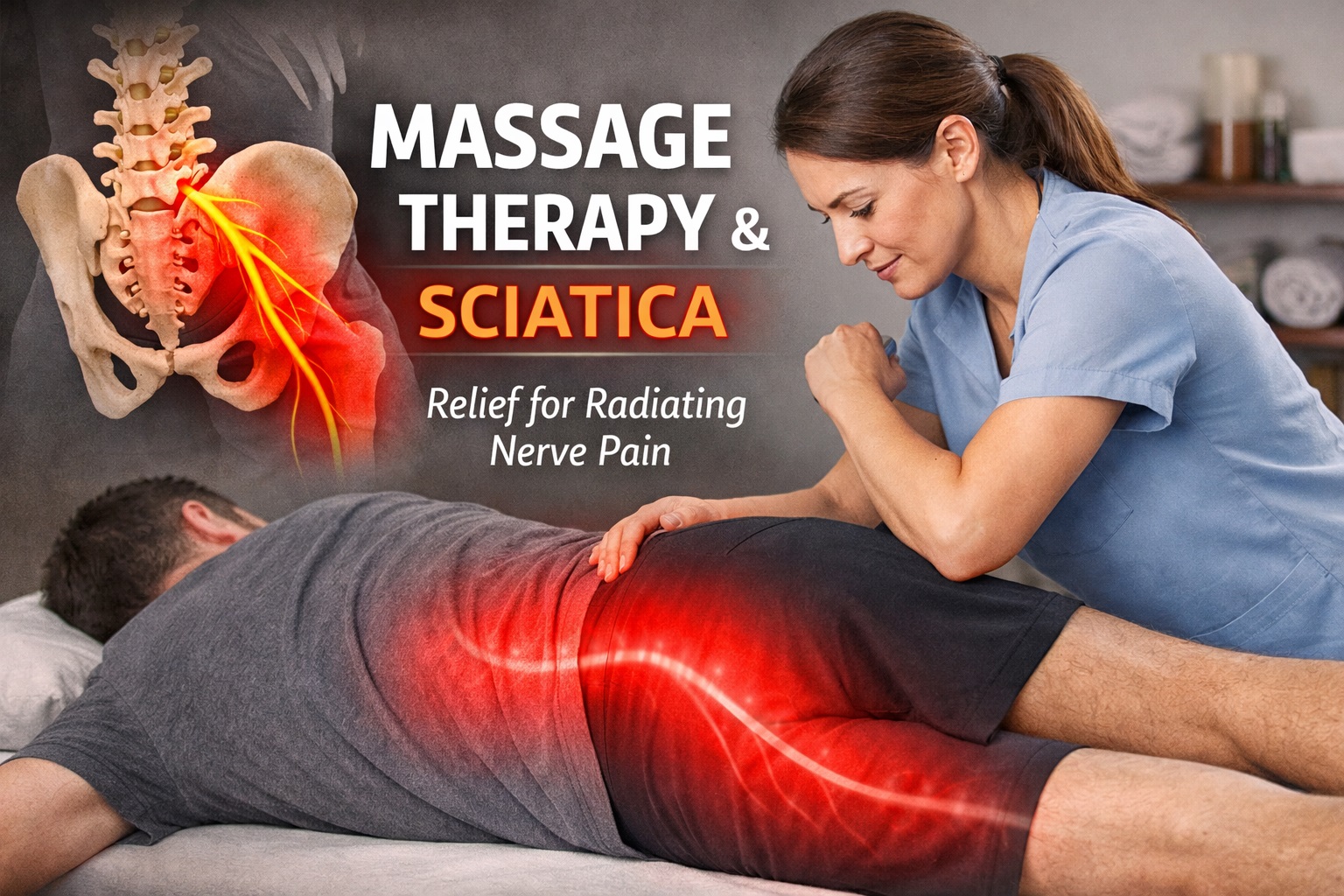
How Massage Therapy Can Support Clients With Sciatica
Sciatica is a common complaint in massage therapy settings — not just among athletes or laborers, but across all lifestyles. Clients may arrive describing sharp, radiating pain down one leg, tingling in the foot, or a deep ache that seems to “travel.” These symptoms often trace back to irritation or compression of the sciatic nerve. Understanding sciatica, how it presents, and how massage therapy can support comfort and mobility helps you provide safe, effective, and client-centered care.
What Is Sciatica?
Sciatica isn’t a diagnosis itself — it’s a symptom pattern involving pain that follows the sciatic nerve pathway. The sciatic nerve is the body’s largest nerve, running from the lower back through the buttock and down each leg. When this nerve is irritated — whether by disc bulge, muscle tension, spinal degeneration, or biomechanical imbalance — clients may experience:
- Sharp, shooting pain
- Numbness or tingling
- Weakness in the leg or foot
- Pain that worsens with sitting or bending (mayoclinic.org)
Understanding this pattern helps you differentiate sciatica from other low back or hip issues and tailor your approach accordingly.
How Massage Therapy Can Help (and What It Can’t Do)
Massage therapy does not “cure” disc herniations or replace medical treatment, but it can:
- Reduce muscular tension around the lower back, hips, and glutes
- Improve circulation and tissue pliability
- Promote relaxation and support parasympathetic nervous system responses
- Encourage client comfort and functional mobility
Research suggests that massage can decrease pain and disability associated with sciatica when combined with appropriate clinical care and movement strategies, especially when integrated into a broader recovery plan. (ncbi.nlm.nih.gov)
Practical Clinical Guidelines for Massage Therapists
Here are evidence-aware strategies to support clients with sciatica presentations:
1. Start With Thorough Intake
Ask about:
- Pain location and radiation
- Onset and aggravating/relieving factors
- Impact on daily activities
- Previous imaging or clinical diagnoses
Having a clear picture helps you adapt session goals and techniques.
2. Focus on Surrounding Structures
Sciatica often involves tension in:
- Piriformis and deep gluteal muscles
- Hamstrings
- Lumbar paraspinals
- Hip flexors
Work these areas gently to reduce protective muscle guarding that can contribute to nerve irritation.
3. Use Gentle, Neuro-Aware Techniques
Rather than deep, forceful pressure, choose:
- Long, rhythmic strokes
- Myofascial release
- Gentle stretching
- Neural gliding (with client feedback)
Monitor client response continuously — sensations of tingling, “electric” pain, or sharp discomfort are cues to modify or stop.
4. Integrate Home Strategies
You can reinforce comfort and mobility by suggesting:
- Gentle movement breaks
- Walking and hip mobility exercises (where appropriate)
- Heat or contrast therapy as tolerated
Always encourage clients to check with their clinician before beginning exercise regimens.
When to Suggest Medical Consultation
Certain signs warrant referral or medical evaluation before or alongside massage therapy, including:
- Progressive weakness in the leg
- Loss of bowel or bladder control
- Severe, unrelenting pain
- Fever with back pain
Massage therapists are not diagnosing, but recognizing red flags helps protect clients and promote safe care.
Empower Your Practice With Focused Training
Sciatica is more than a buzzword — it’s a pattern of symptoms that can significantly affect comfort and function. Learning how to differentiate presentations, adapt techniques, and think clinically boosts your confidence and client outcomes.
The Massage Therapy and Sciatica continuing education course at the Somatic Arts & Sciences Institute provides structured, practical guidance designed for massage therapists.
Learn more and enroll:
Massage Therapy and Sciatica
Sources
- Mayo Clinic – Sciatica: Symptoms and Causes
https://www.mayoclinic.org/diseases-conditions/sciatica/symptoms-causes/syc-20377435 - PubMed Central (PMC) – Massage Therapy for Sciatica
https://www.ncbi.nlm.nih.gov/pmc/articles/PMC6070885/ - American Academy of Orthopaedic Surgeons (AAOS) – Sciatica Overview
https://orthoinfo.aaos.org/topic.cfm?topic=A00623 - Cleveland Clinic – Sciatica: Treatment Options and Self-Care
https://my.clevelandclinic.org/health/diseases/14395-sciatica - Harvard Health Publishing – Lower Back Pain and Sciatica
https://www.health.harvard.edu/pain/what-to-know-about-sciatica